
Vharuun Ascendancy
- Home
- Vhur
- People
- Vharuun
- Drive
- Torsion-loom warp drive
The Vharuun Ascendancy takes its name from a conviction that civilization should be able to build beyond the limits it inherits. Its foundry cities transformed Vhur and carried their rival methods into space. Public witnesses are expected to measure completed work, record its cost and challenge those who claim credit for it.
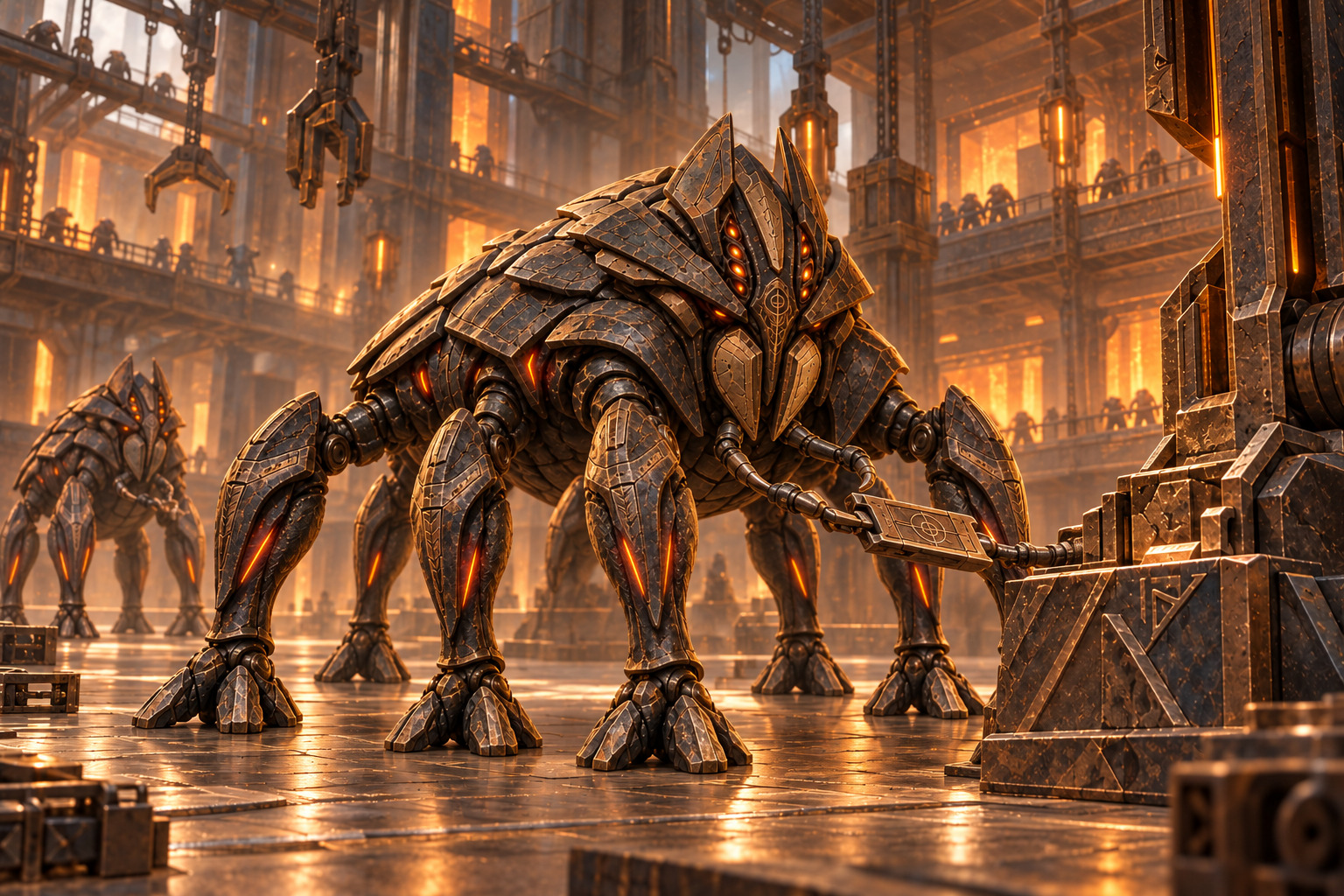
The Vharuun are low-bodied, armored people with six walking limbs and two smaller manipulation palps. Their throat resonators carry precise speech. Their culture prizes practical competence, but engineers can become oligarchs as readily as they become heroes.
The last war left the Ascendancy dependent on foreign precision components. Aderra’s discovery could end that dependence and let smaller cities compete with entrenched industrial houses. It could also give those houses the means to dominate everyone else. Vharuun fleets strike quickly and concentrate force locally. Their hardest decisions concern when ambition has stopped serving the people who bear its weight.
The cities that built Vhur
Vhur’s early cities formed around large shared works: protected reservoirs, thermal galleries and foundations capable of carrying dense settlements over difficult ground. Their names originally described the work for which a community was answerable. Over time, some became industrial houses, others municipal federations, and a few hereditary estates that preferred to keep using the language of common effort.
Witnesses made labor and cost visible. A builder claiming a public achievement had to show what had been completed, who had been injured and which future repairs the structure would require. This was a defense against boastful rulers. It could also become a weapon against workers whose employers controlled which failures entered the record.
The Ascendancy formed when a coalition of smaller cities refused permanent dependence on the oldest foundries. Its early leaders presented technical education and access to industrial tools as public rights. The institutions that grew from that movement are still real sources of pride. A Vharuun child from an obscure settlement can plausibly become a respected designer, though the largest houses would prefer to employ that child before the design becomes public.
During the Twelve-Year War, wartime command concentrated authority in the very houses the founders had tried to restrain. Several cities accepted contracts they could not sustain because refusal would leave their neighbors undefended. The armistice ended the immediate emergency while leaving debt, damaged machinery and a generation trained to believe that withdrawal was someone else’s word for failure.
A different height above the floor
A Vharuun body is low, horizontal and armored. Six strong articulated limbs support its weight, while two smaller palps beneath the forward carapace perform fine manipulation. Paired throat resonators produce speech without a human mouth. A compact sensory crown can draw closer to the protective shell. Personal fittings and identification plates are added to the body; they are not inherited biological rank.
Vharuun rooms have broad turns, low work surfaces and sightlines designed around several bodies sharing a floor. Machinery is commonly accessible from beneath. Vertical human control banks can be used through adapters, but a settlement that endlessly promises adapters while building only human-scale rooms is making a political choice.
Movement expresses mood without making every gesture legible to outsiders. The spacing of the walking limbs can signal fatigue, readiness or a desire to be left room. An interpreter should hesitate before turning a posture into a definitive emotional diagnosis. A tired engineer and an angry engineer may both lower their sensory crown.
The Ascendancy’s armored appearance should not be confused with invulnerability. Bodies tire. Pressure injuries and poorly fitted assistive frames can end a career. Older Vharuun often become formidable partly because they have learned how much unnecessary movement costs.
Public work and private power
The Foundry Assembly brings city delegates together to authorize common defense and major projects. It includes municipal representatives, industrial houses and accredited witnesses. The arrangement deliberately gives those who pay and those who know the machinery a place in the same room. It does not guarantee that people injured by a project can afford to reach that room.
The Hearthward leagues favor repairs, apprenticeships and investment in communities the war left behind. The Reachbound want expansion and the removal of foreign industrial dependencies. The Open Works movement demands public access to tools and design archives controlled by major houses. Their disputes cut across age and occupation. A retired admiral can favor restraint; a young machinist can support expansion because a stagnant home city offers no future.
The Ember Directorate is the common naval command. It is subordinate to the Assembly but commands ships whose crews may answer culturally and financially to different cities. A speaker’s authority comes from a defined mandate and the people willing to witness its execution. Rauk can have broad respect without the power to order every Vharuun fleet to stand down.
At its worst, the system allows a powerful house to turn every failure into a new debt owed to itself. At its best, a public record lets smaller cities make a case that no admiral can simply erase. The struggle over the Garden will be a struggle over who gets to manufacture the future and who is expected merely to work inside it.
Work is not the whole of a life
Cinder Rest is a city of repair halls, domestic galleries and old thermal chambers converted into public rooms. Its largest civic hall still contains the supports of the reservoir that paid for the original settlement. Workers complain that visiting speakers praise those supports more often than they fund the leaking roof above them.
Vharuun art uses vibration, shadow and changing surface temperature as well as sight. A recital can pass through a communal floor while an audience rests on folded walking limbs. Translated performances give organic outsiders and Nacre guests something they can experience without claiming to reproduce every sensation. A disappointing translation can start an argument that lasts longer than the performance.
Competitive climbing is popular in engineered low-gravity arenas. Teams solve routes that change as the structure rotates, combining precise foot placement with enough theatrical risk to scandalize safety inspectors. The best athletes are not necessarily good engineers. Fans know this, although industrial houses persist in recruiting them for recruitment posters.
Family arrangements vary by city. Apprentices can live with a work household without surrendering ties to their birth family. Informal kinship can become more important than legal lineage after a war scatters a district. Vharuun elders sometimes complain that young people keep too many names for their relations. Young people answer that the elders keep too many names for dead machines.
The weight left for others
The Deep Bearing tradition teaches that a life is judged by the burdens it passes on as well as by its visible achievements. Its religious branches hold that the dead remain present through the material effects of their work. Secular adherents arrive at much the same practice without believing that a departed person is watching. A repaired bridge can matter to both.
The Unfinished House movement rejects the idea that descendants must spend their lives completing an ancestor’s ambition. It favors monuments that visibly stop where the dead builder stopped, allowing the living to choose another use for the site. To critics, this looks like abandonment. To its adherents, endlessly conscripting the living is the less respectful act.
Funerary gatherings record failures as well as accomplishments. The custom can be compassionate when a family acknowledges how hard a person’s work was. It can be cruel when a rival uses grief to settle an old dispute. Rauk’s generation tends to trust the public record. Tavra’s asks who had the power to speak while it was being made.
Speed and the cost of staying
The Ascendancy favors fast concentration against a chosen target. Skitter Scouts locate an opening; Breachmaw Assault Ships exploit it; Writclaw Cruisers hold the engagement together. A Kilncrown Command Ship coordinates a force whose captains may not share a political patron. The Last Mandate Dreadnought carries the weight of a decision few cities can afford to repeat.
Vharuun vessels are faster and more aggressive in the current combat design than their heavy appearance might suggest. They pay for that pressure in defensive endurance. A commander who mistakes bronze armor for permission to remain under sustained fire will lose ships that should have withdrawn and struck elsewhere.
Their fleets can threaten a yard, destroy a military storage installation or land engineers on an occupied moon. They do not need to own an invisible road through space. A target is valuable because it contains people, machinery, resources or political authority that cannot simply fly away.
The Ascendancy’s military danger is the promise of the next decisive effort. A house that has already sacrificed heavily can regard withdrawal as proof that its earlier losses were wasted. Good commanders define what success permits them to stop doing. Others keep redefining it until an entire city has paid for one officer’s refusal to admit a limit.
The chance to build without permission
Aderra’s Garden offers an answer to a grievance that many outsiders underestimate. Vharuun cities possess excellent heavy industry yet depend on imported precision components whose licenses and supply contracts remain shaped by the armistice. The discovery could let them rebuild without accepting another power’s conditions. That is a legitimate aspiration, even when an industrial house uses it to justify theft.
Vharuun communities on Aderra have their own claims. Some built surface foundations above the buried complex and regard the colony as home. They may support the Ascendancy culturally while refusing to become its pretext for intervention. A Vharuun civilian can ask Rauk to protect their district and tell him to leave the planetary government alone.
The Open Works movement sees a chance to make an industrial breakthrough widely available. The largest houses want exclusive concessions. Hearthward delegates ask why another distant project deserves investment before ruined districts on Vhur. The Garden can divide an Ascendancy fleet before an enemy fires on it.
An ordinary life
Tavra’s younger sibling, Jeren, runs a mobility-frame workshop in Cinder Rest on Vhur. Before the discovery, they had already taken a municipal repair assignment on Flint, leaving colleagues to keep the home workshop open. The work serves injured veterans whose pensions arrive irregularly. A Garden-grown joint could last longer and fit better than anything Jeren can buy through an industrial house. When a patron offers a shipment in exchange for public support for intervention on Aderra, the decision is immediate and personal.
Jeren knows exactly whose pain would be relieved. They also know that gratitude from those customers could be turned into a political endorsement they never intended to give.
Things you might notice
A civic recital felt through six points of contact with a resonant floor
An old identification plate fitted carefully to a new assistive frame
Warm mineral dust rising when a workshop door opens
Children racing along the underside of a low-gravity practice scaffold
A question within the faction
Industrial independence can free smaller communities or give the largest builders unprecedented power.